BoardGameWire is proud to be sponsored by:




More than half of board game designers responding to a Tabletop Game Designers Association member survey say they have used generative AI for some elements of their work.
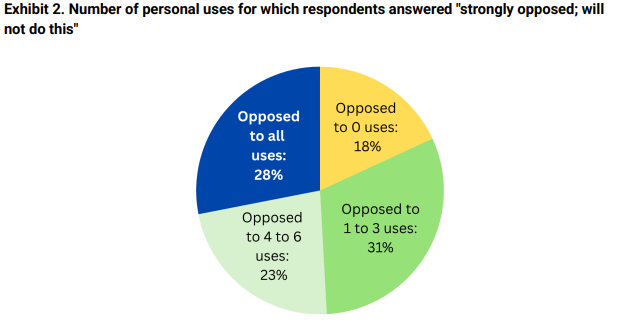
About a quarter of the 171 designers who answered the TTGDA survey said they had used a genAI platform to come up with game ideas or mechanisms – while more than half indicated they were ‘strongly opposed’ to using AI in that way.
TTGDA – a professional organisation launched in 2024 to advocate for tabletop game creators in North America – asked designers about seven use cases, comprising:
● Coming up with ideas for games or mechanisms
● Writing placeholder text
● Writing text for the final version of a published game
● Editing or proofreading text
● Making placeholder art
● Making art for the final version of a published game
● Creating marketing materials for a game
The organisation said that while 28% of respondents were ‘strongly opposed’ to all seven use cases, almost a fifth were not strongly opposed to any of them, with the remaining respondents offering a mix of use cases they consider either acceptable or not.
TTGDA’s report of its findings stated, “In the free-response section of the survey, multiple designers said that the process of chatting with the AI particularly helped them better articulate their own goals or ideas for a game.
“One said, ‘It’s like asking another human who may not know much about games. They know enough to at least bounce a couple ideas, which ends up with me getting to where I want to go’.
“Several designers who had tried asking generative AI platforms to come up with its own ideas described the material they got from the AI with terms such as ‘derivative’ or ‘slop’.
“One designer said that when they tried to prompt an AI for ideas, the AI recommended inappropriate mechanisms from mass market games, like ‘lose a turn’.
“Some said that a fraction of the output from their prompts would contain nuggets of useful ideas or angles that were worth considering.”
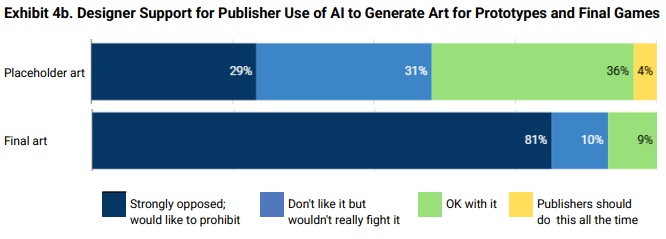
The results for use of AI art in final products were much more clear cut, with roughly four out of five respondents ‘strongly opposed’, and only two respondents out of the 171 saying they either regularly or occasionally generate art with AI that they plan to keep in a final game.
Many more designers (30%) were accepting of using AI to generate placeholder art for their designs – but 39% of respondents were ‘strongly opposed’ to that use.
TTGDA’s report cited one respondent as saying, “Publishers want pretty prototypes and the AI art makes me better able to illustrate the narrative direction and make play less boring than it would be with black and white words or “close enough” illustrations. Some of the games I am working on have no illustrations in the real world that anyone has done and if I wanted those I would have to pay artists which I cannot afford to do.”
But it added that other designers said AI assistants had failed to create usable placeholder art in response to their prompts, with several saying that after trying AI-generated placeholder art they had returned to clipart and other online searches.
TTGDA said that when asked how they feel about publishers using AI for placeholder art, 40% of respondents said they would be ok with it, but 29% would like to contractually prohibit it and another 31% said they ‘don’t like it, but wouldn’t really fight it’.
The report added, “Of all the AI uses that the survey asked about, editing and proofreading had the lowest
number of ‘strongly opposed’ responses, at 35% for personal use and 30% for publisher use.
“About a quarter of designers (28%) are using AI to edit things they’ve written at least occasionally.
“Some designers gave examples of AI not working well as an editor for their games, saying it ‘made the rulebook worse’, or ‘creates more problems than it solves’.
“The problems they described included hallucinations and inappropriate tone. Designers also raised concerns that publishers might use AI for proofreading without a final human check, leaving the game vulnerable to errors.”
TTGDA also noted that more than 80% of respondents did not want publishers to use AI to generate marketing materials for their games, with multiple designers commenting that they were turned off by the use of AI in content creation around games, and will not work with influencers who use genAI in their workflow.
The report noted that of issues raised by designers when asked about their concerns around AI, “the most commonly voiced concern was that current generative AI tools are based on plagiarism, because they were trained on art and written materials without the creators’ consent.”
It noted, “Many said things like, ‘All uses of stolen material are problematic’. Multiple designers also mentioned that they want contract language that will prohibit a publisher from allowing AIs to be further trained on their game materials.
“The next most common concern was AI’s high environmental cost. A ChatGPT request uses ten times more electricity than a typical Google search (2.0Wh vs 0.3Wh). Other impacts include the use of rare earth elements, mercury, and lead in data center equipment; and the use of large amounts of water for cooling.
“Some designers worry that AI could flood the market with bad games. One designer thought it would be easy for unethical publishers to quickly create ‘clones that are slightly different’ and crowd the games they are copying out of the market.
“Another designer worried that ‘AI is great at making things that look like games for crowd funding campaigns, but without actual rules that make sense’.
“The general sentiment from these and other designers was the worry that in a market where it is already difficult for a game to stand out, these practices will only make it harder.”
Recent Repercussions
TTGDA’s report comes just over a month after Ryan Dancey, a more than 30-year veteran of the tabletop gaming industry, lost his COO job at publisher Alderac Entertainment Group after saying AI could generate game ideas as good as his company’s titles Tiny Towns and Cubitos.
Dancey said Alderac CEO John Zinser told him it was time to “move on to new adventures” in the “aftermath” of his LinkedIn post discussing the use of AI in board game design, which quickly attracted a flurry of negative comments from tabletop designers, AEG’s business partners and bodies such as the Tabletop Game Designers Association, as well as board gamers across social media.
Wingspan designer Elizabeth Hargrave, the co-founder of TTGDA, dismissed Dancey’s suggestion when speaking to BoardGameWire the day after his departure from AEG.
She said at the time, “I absolutely do not think AI could be prompted to come up with even the basic idea for those games, let alone a fully fleshed out ruleset for them. For fun, I’ve prompted several different options for ideas for Wingspan cards and not one of them has given me an actionable idea.
“I had a friend who ran a rulebook through AI for proofreading and it hallucinated that people needed to shout ‘bingo’. Apparently that’s AI’s conception of board games right now.”
She told BoardGameWire at the time that the TTGDA board had been discussing the use of AI in board game design, adding that it was “a conversation we need to have with our membership”.

She said, “We’re working on a model contract to offer to our members right now, and that will offer a clause that designers can request that will require publishers not to use AI in their final product. A lot of contracts ask us to certify that a board game design is our own, and not plagiarized.
“It’s my opinion that using AI in a final product goes against that, because it’s using a machine that’s built entirely on plagiarism.”
Hargrave added last month, “I do see people using AI for things like generating a bunch of placeholder names in a prototype. They’re often clunky options but they do the job when you know everything will change 50 times before you’re done anyway. I’m not aware of anyone who has successfully actually gotten good, original ideas for mechanisms from AI.
“What I wish we were talking about is how AI could be built to help designers run models of their games repeatedly to catch weird edge cases or broken strategies. I wish someone would build that tool instead of the language models that just focus on advanced auto-complete.
“This would never replace actual playtesting with humans for psychology and actual fun, but it might save me some repetitions.”
The TTGDA survey noted that one of the most common additional uses mentioned was as a source for help with probability, mathematics, and thinking about balance.
It said, “In some cases, designers are having the AI write spreadsheet formulas that they then use to do calculations in the spreadsheet. In others, they are simply asking the AI to do calculations.
“However, nearly as many designers said they had quite poor results with asking LLMs to do math, reporting errors and hallucinations. For example, one designer who used ChatGPT to calculate detailed probabilities (e.g. how often a certain set of cards might appear in a starting hand) said when they checked the results, they were wrong ‘roughly 1/4th of the time’. Another called ChatGPT ‘surprisingly bad at maths’.”
Last week board game publisher Awaken Realms responded to a wave of anti-AI art review bombing for its upcoming crowdfund, Concordia: Special Edition, by saying no AI-generated imagery will be used in the finished game.
Awaken Realms is one of highest-profile tabletop publishers to confirm it uses AI image generators, with other notable adopters of the technology including Stronghold Games – which attracted significant ire for its use of AI art in its $2.2m More Terraforming Mars! crowdfunding campaign.
The technology has been widely criticised by artists angry that the models are built upon their work without licensing or recompense, in addition to outcry over its environmental costs and threats to jobs in the creative and other industries.