
BoardGameWire is proud to be sponsored by:


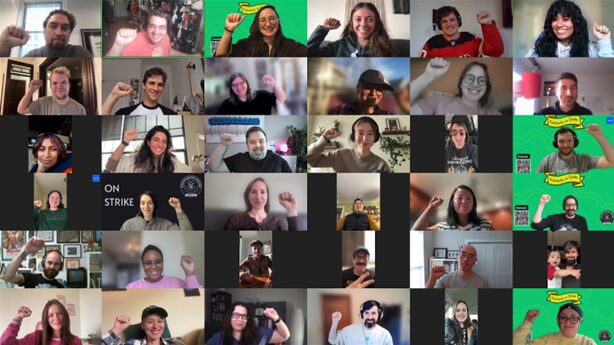
A 42-day strike by workers at crowdfunding giant Kickstarter has ended after the company agreed protections for its long-running four-day work week programme, raising the minimum salary floor and preventing AI from replacing job roles.
Members of the Kickstarter United union had been striking since October 2 after months of talks with management over a new collective bargaining agreement stalled.
The union said ahead of the strike that Kickstarter had rejected every proposal for a minimum salary, as well as insisting on retaining the right to return to a five-day, 40-hour workweek.
Kickstarter has been operating a 32-hour, four-day work week since introducing a pilot scheme in April 2022 – but Kickstarter United said in October that management wanted to retain the right to both temporarily and permanently alter work schedules back to 40 hours across five days.
Kickstarter employees were among the first workers at a major US tech company to form a union when they created Kickstarter United in 2020, and the organisation ratified its first collective bargaining agreement in the summer of 2022.
That agreement, which covered 59 community support specialists, trust and safety analysts, marketing professionals, software engineers, and other tech workers, expired on July 13 this year, and since April the Kickstarter United bargaining committee has been attempting to reach a tentative agreement with the company’s management.
The six-week strike action has now persuaded Kickstarter to codify the four-day workweek, while any temporary shifts to a five-day workweek must be “justified” and provided with advance notice and a time limit.
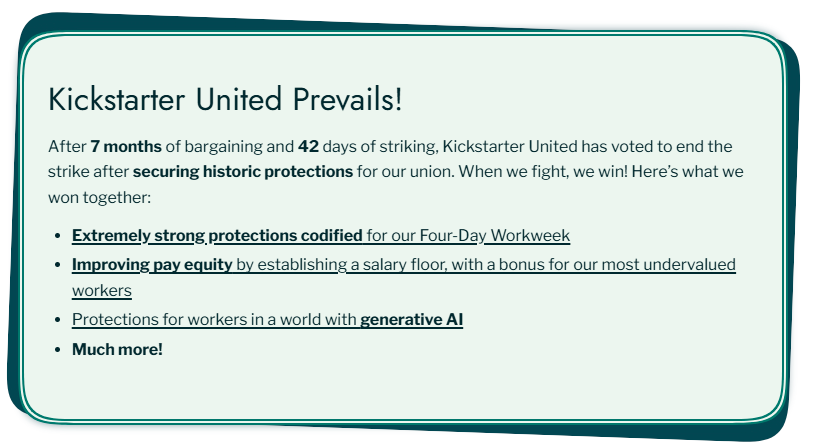
Workers will also see an escalating increase in the pay floor based on cost of living, which Kickstarter United said would represent an average 6% increase “to our most undervalued workers” – who will also receive a one-off $6,000 bonus.
The union had been demanding a minimum salary of $85,000, which it said corresponds with what is considered low income in New York City.
Other protections secured by the union mean Kickstarter cannot replace roles with AI, and that management must work with employees if AI changes a role.
It added that it had also secured “strong protections” against replacing full time employees with contractors.
Nick Galipeau, secretary-treasurer of the OPEIU Local 153 union which includes Kickstarter United, said, “When we fight, we win and that’s what happened today for Kickstarter United.
“Progress takes time and while we never want workers to go on strike, we are thankful that the action by Kickstarter United members brought them the workplace stability they deserve.
“This was always about fair pay and stability for workers.”
Dannel Jurado, a Kickstarter United member, steward and collective bargaining committee member, added, “It is through the solidarity and steadfast resolve of my coworkers and union that we achieved this victory.
“For 42 days we sustained a historic and novel remote strike that won protections for the working hours we’ve already been doing for years, protections that continue to make Kickstarter the great place to work that we know it is.
“The workers fought for this victory and hope that it can inspire other workplaces and unions to not just accept the status quo but fight for a better workplace of their own.”
Kickstarter has faced increasing competition in the tabletop gaming space over the last couple of years, with the rise of former pledge manager competitor Gamefound as the often go-to platform for large-scale, miniatures heavy tabletop fundraises.
The crowdfunding veteran remained top dog in tabletop last year, with about $220m of project funding compared to Gamefound’s $85m.
That figure for Kickstarter has fallen for three years in a row, however, and is well down on the record $270m the platform recorded in 2021.
Kickstarter’s total dollars raised from January to September this year stood at about $67m according to Tabletop Analytics data – down almost 20% on the same period last year. But the number of projects on the platform across that period has soared 30%, to more than 1,200.
Earlier this year Kickstarter brought in new pledge management and pay-in-installments options amid the increasing competition, acknowledging they were post-campaign tools its “creators have been asking for”.


[…] 1 quedó muy cerca de Les Derniers Droïdes .Finaliza la huelga de los trabajadores de Kickstarterhttps://boardgamewire.com/index.php/2025/11/13/kickstarter-workers-celebrate-end-to-42-day-strike-af…https://jemmagazin.hu/jem-hirek-46-het/La huelga de 42 días en Kickstarter ha finalizado tras […]
[…] de 42 dias, é um marco fundamental na nova era das relações trabalhistas. Segundo a notícia do BoardGameWire, o sindicato Kickstarter United (OPEIU Local 153) conseguiu não apenas codificar a semana de […]