BoardGameWire is proud to be sponsored by:


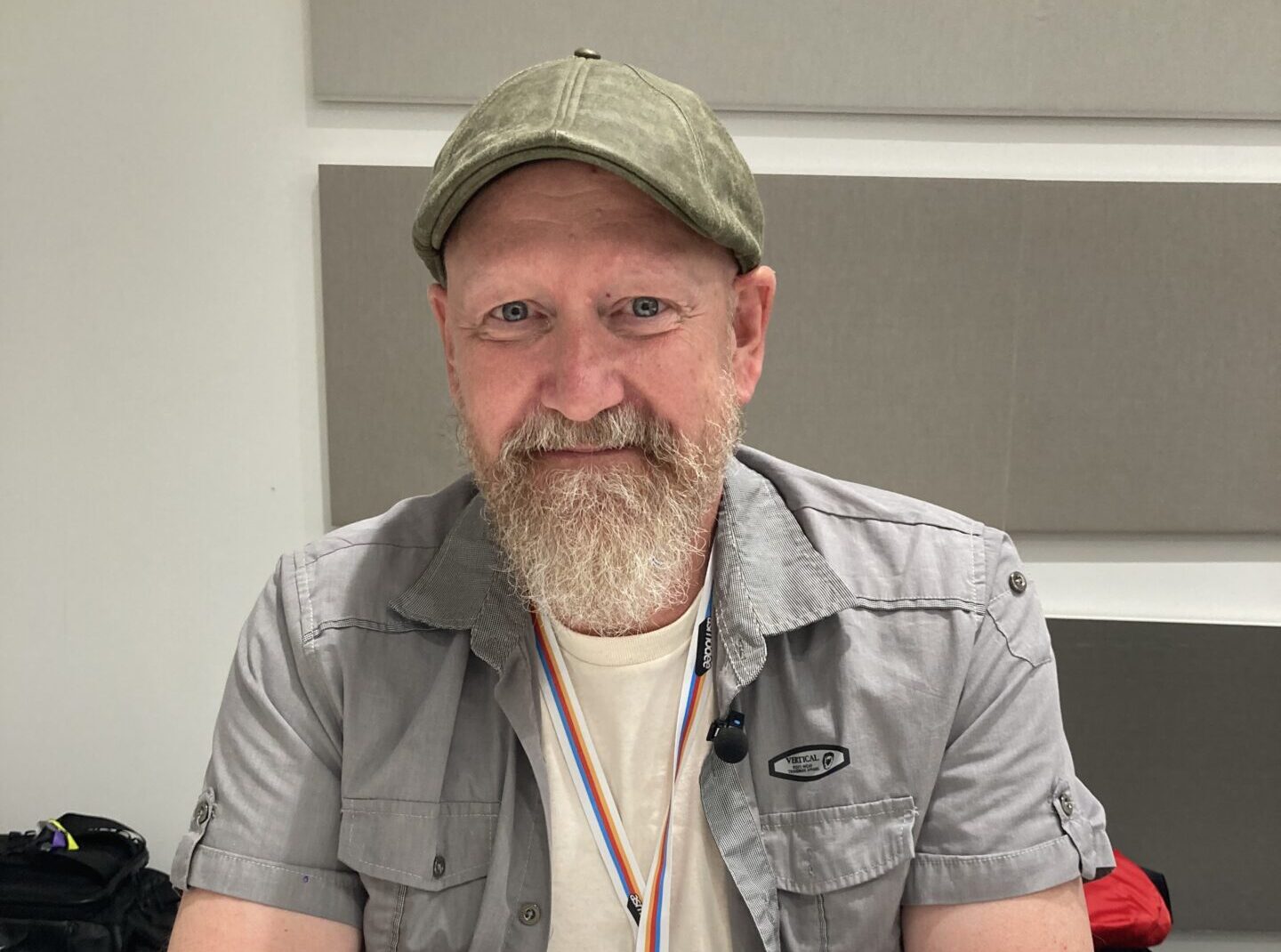
When news broke three months ago that board game giant Asmodee had been named manager of the hugely lucrative Middle-earth licence for tabletop games and accessories, questions naturally abounded within the industry about what that would mean for other publishers hoping to create The Hobbit or Lord of the Rings-based titles. Luke Peterschmidt, the tabletop veteran tasked with running the Middle-earth operation at Asmodee, sat down with BoardGameWire at Spiel Essen following the announcement to outline his vision for the IP, what they want from publishers in terms of pitches, and how they hope to prove naysayers of the deal wrong.
—
BoardGameWire: Hi Luke! So a good place to start would be: what were you doing prior to becoming Head of Active Category Management at Asmodee?
Luke Peterschmidt: Before this I was the senior vice president of all the tabletop games for Asmodee, which meant that I ran all of the studios in what we call the tabletop vertical. We have lifestyle – that’s our hardcore games. We have our social games, which are like our lighter party games, and then all the stuff most people think of as tabletop games – so that would be Space Cowboys, Rebel, Office Dog, Z-Man, there’s seven or eight others. So my job was to run all those studios.
I guess the major question about this is how will it work, specifically in terms of third parties coming to you guys saying: “I’ve got a lot of the Rings game. How do we progress?”
Yeah, that’s a great question. Can I back up and answer a different question first? Existing Lord of the Rings games – because there’s a lot of Lord of the Rings games that are not Asmodee that are out right now – nothing changes for them. They still work through [former Embracer Group arm Middle-earth Enterprises]. The thing that will change for them is that we, as Asmodee, in this new role are going to start doing activations, marketing activations, where we will include everybody, whether they’re part of the ‘new regime’ after the deal or the regime before. We have no interest in making anybody’s life worse, or cancelling anybody else’s game.
So that’s the past, backwards. Looking, forward – anybody who wants to pitch us a game, who’s a publisher, can come to us and pitch us a game. My team is publisher agnostic. Asmodee gets no points for an Asmodee studio pitching us a game – and on the distribution side, because Asmodee does a lot of distribution as well, if you use Asmodee distribution, you get no extra points. Our job is to make the right number of Middle-earth games at the right pace, so that every game has space to breathe, and there is a Middle-earth game or gaming accessory for every type of game.
That’s the mission, and no part of that mission says, “and Asmodee makes all the games”. So at this show at [Spiel Essen], in fact, the meeting right before this was a game designer pitching us a game which was not an Asmodee pitch. It was a great pitch. That was a designer pitching us. So we told that designer, that was a good idea, we think, but you need to go find a publisher, because we’re going to work with publishers, not individual designers, right? So if you’re a game designer out there: go find a publisher first, and then have the publisher come and pitch to us.
In the case where a good game designer comes to us, we will introduce them to publishers, we will introduce them to our own studios – who may or may not have time or competency for that type of game. Because our studios right now, if they were to add something to their list, they’d have to pull something sort of ‘off the wall’. Our bandwidth isn’t infinite, and they have their own strategies that have been in place a long time.
So a publisher pitches to us, they would show us the games, they’d show us maybe the art style they’re going with – which we can talk about more later – they would show us their ideal release date. The ideal release date will probably never be the date they actually release on. Not because of their schedule, because of our schedule. That thing I said about not having things stack on top of each other, we can’t let everyone say “and I’m releasing at Essen”, or there’ll be four Lord of the Rings games in Essen, right? That’s not fair to any of them. We need every game to have a chance to succeed.
So we will then take our calendar and we’ll start mapping releases on that calendar that we think is the right pace: not too much, nothing’s too close to each other thematically, nothing’s too close to each other visually. You know, we’re never gonna let people run two crowdfunding campaigns at the same time, from two publishers. That would be bad.
So do you anticipate it being, say: one big euro a year, one trick taker, etc?
That’s a great question that I don’t have a good answer for right now. We are in the process of building our calendar, and then we’re going to sit down with [Middle-earth Enterprises], because although we represent Middle-earth as sort of the first group of people to organize what pitches get through, they’re still going to make the final decision, right? But we need a confidence level of like 95% that if something gets past us, and Middle-earth doesn’t say, yes, we’ve failed – or there’s something we didn’t know, like just an old, pre-existing deal that we didn’t know about. That’s our hope.
So the right number of games, we’re still working on, right number of gaming accessories we’re still working on. Some games will be region specific, probably, I don’t know for sure, but someone might come to us with a publisher who says, like, you know, we’re really, really big in Armenia. Great: you can have Armenian rights, this Armenian game, but you have no distribution outside of there. So they would be sort of on their own timeline – they’re not gonna compete with much.
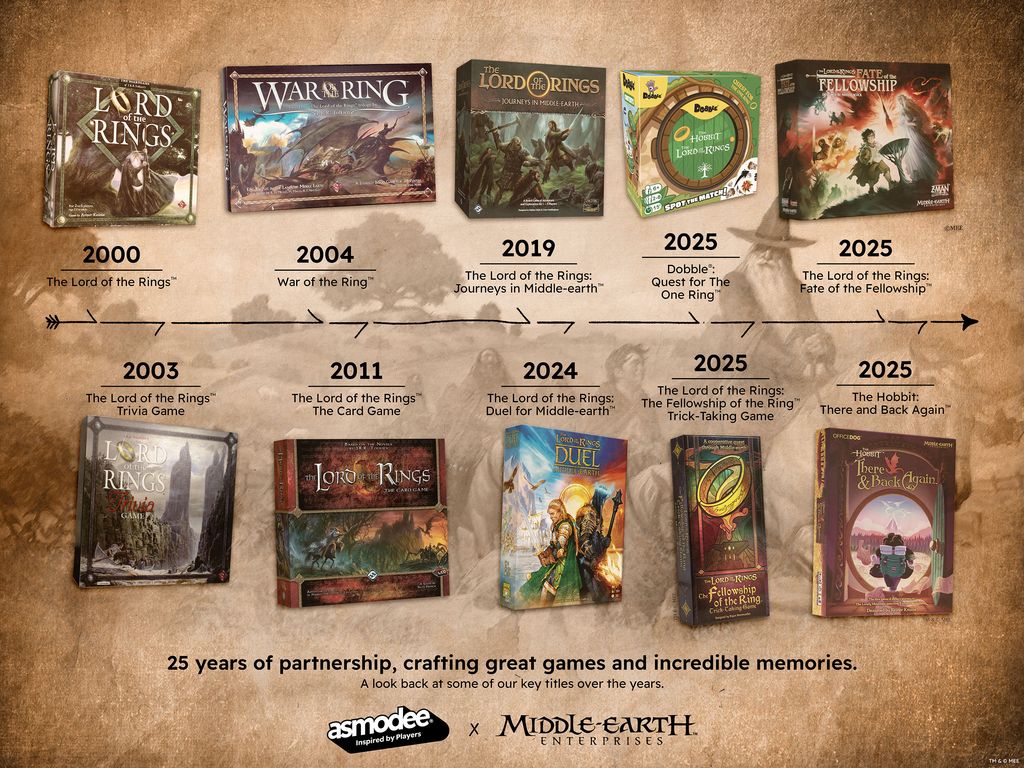
We have some experience recently with the studio internally for releasing a series of Lord of the Rings games. We started with the trick taking game, and then we did the Pandemic game, and then the hobbit game, and those games are very similar to the concept we’re going with now, pacing wise: all those games are different. All those games have been successful, by the way: like, they’ve all had a chance to be successful, which is great. So we’re going to be rational. And one of the reasons Middle-earth picked us for this deal is they trust our experience in the space. My team is not that large, but if I need an opinion about how to do press, I can talk to this guy. If I needed an opinion about some lifestyle game that maybe I’m not an expert in, I can just call someone and go, ‘hey, roleplaying team, help me out here. Is this great? It feels great to me’.

This does give Asmodee a lot of power, obviously. And there is the potential for conflicts, if, for example, a third-party publisher brings a Lord of the Rings trick taking game to you next year, and it’s very, very good.
Well, we wouldn’t say yes to it because we have a successful one – not our successful one – but we have a successful one in the marketplace. If someone brought us a game that was a direct competitor for War of the Ring, and War of the Ring is still doing well, we’d probably say no to that too. I think people are right to… it’s reasonable for them to not trust the things I’m saying. And I hope that in the next couple of months we will prove to the world that we mean what we say, because we’ll be announcing our first group of licensees. And, we have a lot of work on the back end, just ticky tack stuff like getting our contracts ready and making sure all that works, and ironing out some smooth processes that are boring to everybody but required by everybody, that might slow that down [Note: this interview was conducted at the end of October 2025, and those announcements are still yet to be revealed].
But when those announcements come out, I think people are going to be happy to understand that it’s not just that we will work with external people, but we will also work with smaller companies. Middle-earth has a long tradition of working with microscopic licensees – like, they have a licensee that makes honey only from the flowers grown on The Hobbit set. They have a licensee in Minneapolis that makes guitar effects pedals. They make two different effects pedals, and they probably sell a handful – I don’t know what their sales are, I have no idea. And they’re amazing, and they’re handcrafted and built, right? We don’t want to lose that magic. This is a handcrafted brand – a lot of people feel this brand in their bones. I will never not be impressed by the love for this brand. The level of knowledge super fans have is out of this world. It’s just impressive.
It’s good to hear you say that. And obviously there has to be a lot of trust and goodwill on your side if it’s going to work.
We got to build it up! We got to build it up, yeah, we got to – we’ve got to walk the walk.
But the initial reaction from some people within the industry I spoke to was ‘Well, that just means Asmodee are going to call all the shots, we’re not going to get a look in now’. Like, on paper, fine, yeah, there’s a process, but in reality, you’re going to win out if there’s ever any conflict.
It is absolutely fair to have that thought in your head, and it’s our job to prove that thought wrong. And I mean literally nothing I say, I think, could convince anybody other than action. So yeah, it’s got to be the action, we’ve got to follow it up. And look, we’re an industry of tremendous companies. Like, I love Asmodee, it makes amazing games. I spent many, many, years here working on amazing Lord of the Rings games for people. But there’s amazing games in this hall from everybody. Like, they’re amazing.
What does your ideal slate look like then, at the end of 2026?
Oh, games take so many years to make that the first deals we will be announcing, those games won’t come out for two and a half years, like: games take two and a half years to make. So we will be announcing a slate of who we’re signing and maybe what those games are if the publisher chooses to say, you know, in a reasonable number of months, if you didn’t include the holiday months. Because this interview is in October – we’ve got Thanksgiving in the United States, and we’ve got Christmas coming up, and everyone takes vacations in those months, so the back and forth slows down to a crawl. But yeah, I’m hoping to have something fairly soon that we can talk about: but please write off most of November and December, because everyone’s taking all their vacation days that they haven’t taken yet. American companies aren’t like European companies, where you all take a month off in August. We all don’t take any vacation, and at the end of the year, we go, if we don’t take it right now, we’re never getting it [laughs]. And they slam it all into November and December. And I’m talking about myself [laughs].
You’ve touched upon this already, but I get the sense it’s gonna be a real balancing act. To some extent, if you print more Lord of the Rings games, you make more money because they’re very popular, and people want them, and they want different types. But that’s a tough tightrope to walk, in not accidentally making too many, right?
Yes. And I frame this as: Lord of the Rings is the grandfather of all fantasy IPs. We had this term when I used to work decades ago at Wizards of the Coast, called the JOTWA, which was just another Tolkein world, right? And there’s so many. We don’t think, when we look at the games in the hall here and we see medieval fantasy themed games: we’ll never say there’s too many of those, right? There’s a game about a tavern, there’s a game about building a castle, there’s a game about… whatever. In my mind, if all of those medieval games that we don’t see as competing now… they’re all using Middle Earth elements now, they’re all using elves, they’re all using dwarves. They might call their hobbits halflings, but they’re all there.
So I’m not too worried about too many Lord of the Rings games. I’m worried about too many Lord of the Rings games that are too similar. So when you said trick-taking game pitching, that would be such a quick no for me, and it’d be such a quick no because there’s already one of those, and it’s doing well, and that game deserves time to breathe. I come from a game design background and I would be furious if I had a successful game, and then another game got launched that was mechanically close, appeals to the same person. And there are a lot of types of games that don’t exist for Lord of the Rings. Is there a big, heavy, euro Lord of the Rings game somewhere out there? I don’t know of one, right? There’s just space. Is there a kids game? Has anyone taken a funny shot at Lord of the Rings? Like, I don’t know – Hobbit breakfast! I want someone to bring these pitches.
This raises an interesting point, though. So obviously you’re accepting pitches, but when you have ideas such as this, is there license for you to reach out to publishers and say ‘look, we’d actually like this type of Lord of the Rings game made’?
I am so happy you asked that question. So my team is called the active category management team, and the difference is that we are active. When we get to a place – we’re not there yet, because we’re still getting our processes in place – we will actively reach out to partners and say, ‘We need a game like this, and we think you have particular skills in games like that’. Now we might make that reach out, and it’ll take three years before you’ll see a product. And we might take that reach out, and they might just say no. But absolutely: we are actively looking for people for both games and game accessories. Actively is the key word – that’s why we’re here. We’re not waiting. You know, most people that do licensing wouldn’t be at this show accepting pitches. They’d be at home waiting for a phone call from someone who’s interested. My name was on that press release so that people could reach out and contact me and say, I want a meeting. And they did, because turns out, gamers and Lord of rings, that Venn diagram is a bullseye.
And how’s that turned out during this Spiel Essen so far?
We’ve had a lot of pitches – and I can’t talk about the pitches themselves, but there are trends. And it’s so interesting that the trends in games… if you look at games as culture, the culture of today, the stresses of today, are absolutely affecting the styles of game pitches we saw, it’s super interesting. And in a year, I’m gonna write a blog post, and we’ll do another interview, and I’ll explain what I’m talking about. I can’t ruin the confidentiality of the game pitches, but it’s really interesting.
Maybe you can’t talk about this, but I’ll try. So you mentioned heavy euro, which, you know, God yes, that’d be awesome – is there a market for that? I’ve spoken to other publishers in this show who’ve specifically said heavy euros – big, expensive, heavy euros – that the market’s just not really there at the moment. Some will sell, but the market isn’t there. And actually smaller family-plus games, smaller box games, that’s the economic climate we’re in, and that’s really what budgets people have. Is that a concern for you? Or do you just see what turns up?
I think I may be ‘tinted’ by Asmodee’s thought process, which I agree with. I would like to have games at all price points all the time, because at some point the pendulum is going to swing, and we’re never going to guess that right. The odds of us guessing it right are low, and because it takes three years for every euro – probably even longer, right? – I’m not going to say no to that idea, as long as there’s not one in the market. Because in three years, that market may have moved. And look, everyone says low price games sell – until it’s something that people are passionate about. Our recent launch of Fate of the Fellowship, the Pandemic game, sold out almost everywhere – and it’s really expensive. So there’s a market for games. It might not be big, but it’s bigger than honey and guitar pedals [laughs]. Which I love – and I will be buying those guitar pedals.
So what element of this deal just hasn’t been talked about yet?
Oh, great, yes, thank you. Okay, this is a literary license. So if you’re out there and you want to make something that looks like the movie, then we would not be the right people to come people to. But more importantly, that means we are open to alternative art styles, and artists, and we are even okay with people taking little elements of the book – well, Middle-earth is okay with taking little elements of the book – and developing them out further. Like, we don’t want to make five ‘throw the ring in the volcano’ games every year, right?
I would love to see – I’m just going to tell you the kinds of games I’d want to be pitched to me. I would like to have pitched to me games that take small elements of the IP and develop them with focus. A Prancing Pony game. A game about, you know, some spot on the map that if you’re a huge Lord of the Rings fan, you know, but if you’re not, you don’t. Let’s talk about it, let’s get deep into it. Some stuff out of the appendices of the third book – those rights get a little bit weird, but they’re available and we can do really fun stuff. There’s a game that is currently in the works that has done some amazing things with the IP, that real fans will be like, ‘Oh, this is different, this is a thing’. So yeah, I think there’s lots of room for different takes on the IP, and don’t expect visual similarity. I want these studios or these external publishers to be able to create a visual look that… you might walk down an aisle and see six Lord of the Rings games, but you’re going to point at one and go, that’s the one from Kosmos, right? That’s the one from whatever, or that’s my favorite art style, you know? Like, I love the art on Flamecraft. I’d love to see, I don’t know what that looks like for The Lord of the Rings, but that’d be pretty cool!
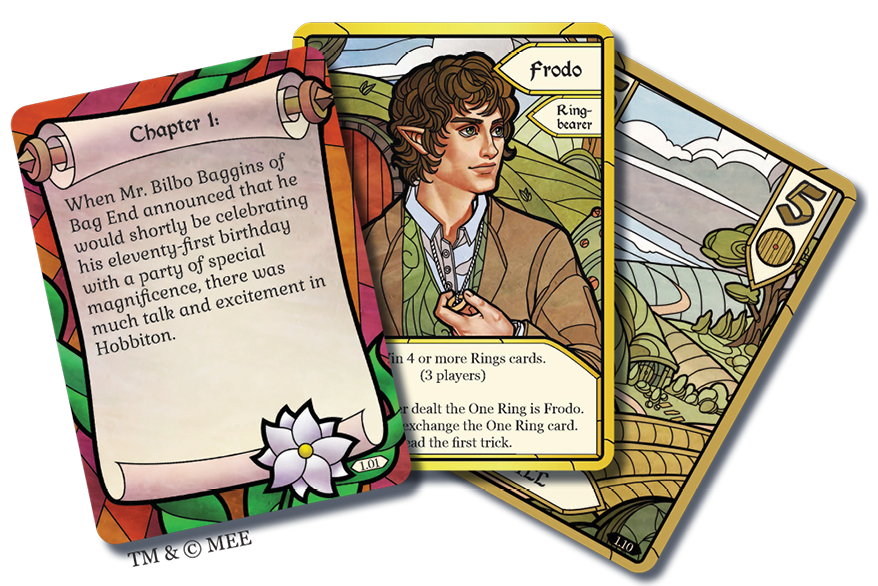
I think the trick taking game is probably a really good example there, because the art on that is incredible and really makes the game sing. It’s a great game, but I was playing a looking at the cards yesterday and thinking ‘this is fantastic’ – the armour on Gimli the dwarf, for example, where it’s chain mail, but it’s just like swishing circles in that stained glass style?
I love the art on that game. I was working on that game early on when I ran that studio, and we picked that style not just for, like, the style, but we picked it because we knew stained glass was the thing that survives in temples for a long time. And we feel like Lord of the Rings survives like a temple for a long time. So we went deep into it with that one. But it was different: no one confused it with a Fantasy Flight product, right? And that’s the goal, and we want to see that. The original drawings – most people don’t know this – the original drawings of Gandalf, he was like, kind of a pudgy dude. Legolas, you know, he’s, he’s a mix of two types of elves, which means there’s a 50/50 chance he has straight white hair or curly brown hair – it’s just that the movie showed him a straight white hair. Somebody wants to do a Legolas with curly hair, bring it. That’s literally, that’s your interpretation.
I guess we’ve seen this with the Lord of the Rings Magic the Gathering set from a couple of years ago, where there was a hugely diverse set of characters.
Yeah, that art was great, full respect to the Magic artist team.
Asmodee launched its own crowdfunding and miniatures operation last year, and has also brought in an RPG specialist in Mike Mearls. How do those things tie into this new operation?
I haven’t had anything pitched from roleplaying games, and there’s a roleplaying game that exists now from Free League that’s really good. [Crowdfunding and miniatures] pitched us an idea, there’s an idea there. We’ve got a couple of pitches for miniatures and crowdfunding from a couple different places. But, everyone has to earn their spot. And I gotta be fair to that team, that team is pretty new here. Not new in experience level – I mean, it’s David Preti, he’s done tremendous things in crowdfunding – but they’re pretty new in the Asmodee world. And we are a big company, and it usually takes a little while to find your place.
Any publishers interested in pitching a Middle-earth game to Asmodee can do so by emailing METTGlicensing@asmodee.com.