BoardGameWire is proud to be sponsored by:


Asmodee has ramped up its reignited acquisition strategy by buying Japon Brand from CMON, anchoring the board game giant’s push into a “currently untapped market” for the company.
Japon Brand was instrumental in bringing Japanese designs such as Love Letter and Machi Koro to international markets, after being inspired by the surge in novel games from home-grown designers in the early 2000s.
The company will form the cornerstone of Asmodee’s new Japanese design studio, Nekuma, which will look to find games from local designers that it can release globally, as well as helping Asmodee bring its existing titles to Japanese players.
Asmodee CEO Thomas Koegler said, “Japan is one of the most creative and culturally influential markets in the world. With Nekuma and the integration of Japon Brand, we are building a long-term platform that connects Japanese creators with players globally.

“True to Asmodee’s entrepreneurial and bold DNA, this capital-light and agile initiative allows us to invest where creativity is thriving while positioning Asmodee for sustainable growth in Asia.”
Asmodee has grown into a board game publishing and distribution giant thanks to the heavy expansion the business undertook after being bought by private equity firm Eurazeo in 2014.
But the vast bulk of the company’s revenue comes from its operations in Europe, which accounted for more than 76% of its €1.6bn net sales in 2025.
The United States contributed about 13.1% of 2025 net sales, while the company’s entire ‘rest of the world’ net sales – covering every country outside of Europe or the Americas – made up less than 5%.
Asmodee currently has offices in South Korea, China and Taiwan following an expansion to the continent in 2021, with those teams having developed and published localised titles including Splendor Pokémon, Love Letter Cookie Run, Pokémon Chips, and Love Letter Fox Spirit, as well as making use of crowdfunding platforms across the region.
The company said Nekuma would “integrate and expand” that activity under interim head of studio Frederic Nugeron, Asmodee’s current global senior vice president – route to market for the Asia Pacific region.
It said Nekuma would lead game sourcing “to identify and support the most promising Japanese and Asian tabletop game designers”, while Asia-focused publishing will be managed by the company’s existing Korea team.
Nugeron said, “Our ambition with Nekuma is very concrete: be present on the ground, listen to designers, understand cultural nuances, and build trusted relationships within the Japanese ecosystem.
“By combining local expertise with Asmodee’s global reach, we can support creators more closely and bring distinctive Asian games to a worldwide audience.”
Asmodee said Japon Brand would continue to operate with its existing expertise and relationships, with “no impact” on current partnerships or contracts.
CMON Divestments Continue
The buyout comes less than two years after board game crowdfunding major CMON acquired Japon Brand, with a plan to keep it as an independent division that would use CMON’s infrastructure and reach to help it introduce games to the global market.
That investment followed a strong 2023 for CMON, in which its net profit jumped more than 35% amid a hefty drop in its sales-associated costs.
But the company has faced a punishing financial situation since, posting losses of $3m across 2024 and nearly $7m for the first half of 2025 – figures which dwarf the overall $4.2m profit it had managed to make over the previous nine years combined.
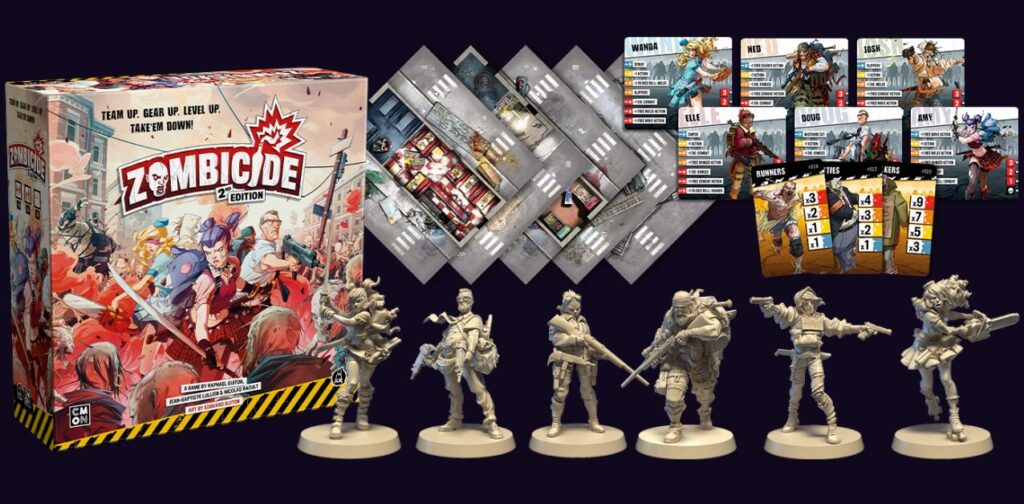
As well as laying off staff and halting new game development and campaign launches, CMON has been attempting to recover by selling a string of its most lucrative IPs – including its most famous and profitable title, Zombicide, and Cthulhu: Death May Die, both of which were bought by Asmodee.
Asmodee continued its acquisitions of CMON games last month by picking up bluffing and set collection game Sheriff of Nottingham, which CMON had previously bought from Brazilian publisher Galapagos Jogos in 2016.
The board game giant announced in November 2024 that it was preparing to “reignite” its strategy of buying up smaller board game publishers and distributors, saying at the time that it had a pipeline of more than 20 acquisition opportunities.
But the revived M&A process is yet to fully mirror Asmodee’s private equity-fuelled buying spree from the latter half of the 2010s, during which it acquired more than 40 companies and IPs.
That heavy expansion included the company adding more than 20 game studios, including Days of Wonder, Fantasy Flight Games, Lookout Games, Catan Studio and Z-Man Games.
Asmodee CEO Thomas Koegler was asked during the company’s quarterly results presentation last month whether the company was ready to make “more meaningful” acquisitions rather than small bolt-on deals.
He said in response, “Without being specific, the activity in the pipeline is in accordance with our plan. The smaller acquisitions are faster. IP acquisitions and asset deals are faster to execute. I’m satisfied.”
Other expansion activity since Asmodee announced its M&A plan has included the company launching a new party games studio, Moodbox Games, as part of a push into the US mass market.
It also recently launched a dedicated kids-focused brand, Asmodee Kids, in preparation for releasing a slate of re-worked, simpler and shorter versions of some of its most popular titles.
Asmodee posted record sales of €524m during the last quarter of 2025 despite a slump in its US performance, with trading card game earnings in Europe acting as a driving force for the business.
The board game giant’s overall net sales jumped 22.2% across October to December 2025 compared to the same period a year earlier, with the performance of products it distributes for other companies surging more than 50%.
Net sales for games published by Asmodee itself fell almost 13% year-on-year in the quarter, however, weighed down by US net sales slumping 23% to €70.4m.
That drop saw the US fall behind both France and the UK in Q3 in terms of the company’s highest-performing countries for net sales, with France surging 47% year-on-year to over €111m, and the UK growing 41% to €82.7m.