
BoardGameWire is proud to be sponsored by:



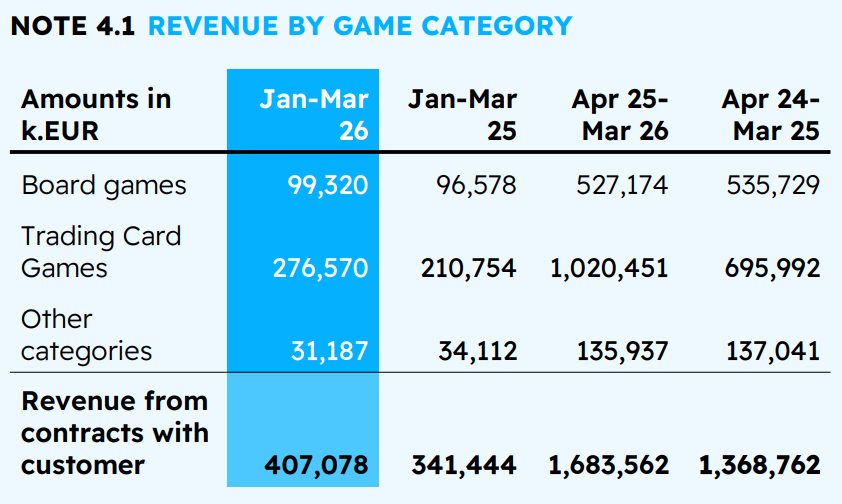
Asmodee’s escalating power as a global TCG distribution giant was evident again in its newly-released annual results, which showed the company’s net sales surging 23% year-on-year to more than €1.68bn.
That annual revenue has swelled around 50% in just three years on the back of huge recent growth in TCGs, including heavyweights Magic: The Gathering and Pokemon as well as a wave of strong performing newcomers such as Disney Lorcana, the One Piece Card Game and Asmodee’s own Star Wars: Unlimited.
Despite Asmodee’s long-time image as a board game publishing heavyweight, more than 72% of its revenue now comes via its distribution of other companies’ games – up from an already hefty 63% in the previous financial year to March 31, 2025.
TCGs now make up the lion’s share of Asmodee’s annual net sales – about 60% in the 2025/26 financial year, up from just over 50% across the preceding 12 month period.
The company’s own board game publishing operation, meanwhile, saw its net sales fall 5.8% in the last financial year – while net sales for the first quarter of this year were down 9.8% compared to the same period in 2025.
Asmodee CEO Thomas Koegler was asked directly during a Q&A session on Asmodee’s latest financial results if the company was still primarily a board game publisher, or whether it was “increasingly becoming an infrastructure company for TCGs”.
He said in response, “We have insisted a lot on the fact that one of the strengths of Asmodee is to be a publisher, but the first strength that we do have is our global reach across all categories, from TCGs and board games.
“That’s the superpower of Asmodee – and then being a very strong publisher is a way of accelerating performance.
“So I would say that there is no change, we continue to capture opportunities across the board wherever they come from… our aim is to be a dominant player, bringing all games to the market, anywhere they can.”
That assertion has been borne out by Asmodee’s recently reignited acquisitions drive, which has seen it pay a hefty €250m for French social and party game publisher ATM Gaming, as well as buying Japon Brand from CMON and individual IPs including Zombicide, Cthulhu: Death May Die and Sheriff of Nottingham.
The Japon Brand buyout was accompanied by Asmodee launching a new Japan-based design studio, Nekuma, anchoring its push into what it described as a “currently untapped market” for the company.
There were also hints in the Q&A session that Asmodee might be considering a move into Japanese distribution, adding to its existing operations in the region across China, Taiwan and Australia.
Koegler said of Japan, “The first move we have done with Japon Brand and setting up Nekuma is more of a sourcing move, right?
“The Japanese game designers and authors’ market is very dynamic. If you look for instance in recent very successful games – Bomb Busters, which is the Spiel des Jahres from 2025, was originated from Japan, a game like Dnup that we are releasing later in the year is coming from Japan.

“So they are very good also at small card games, and we really wanted to, I would say, bolster our publishing capabilities by creating those sourcing activities.
“Distribution wise, for now we are still working with local partners, we have not set direct foot yet.
He added, “It’s a fragmented market, its a very strong TCG market on the local market side, but yes… as I said, it’s a very vivid scene.”
Koegler also made clear that the company is still pursuing M&A opportunities on the publishing side “across all play types that we have, from social games to lifestyle games and tabletop games”.
He said, “I would say that the discussions we have are still as active as they were – we have demonstrated our ability to do various sizes of deals, which is also a very strong signal to potential people that would like to join the Asmodee adventure.”
Koegler said in his introduction to Asmodee’s 2025/26 report that the impact of geopolitical and economic events on the company’s business in the first few months of the year had been limited, but that the firm remained “mindful” of the potential pressures on transport and energy costs.
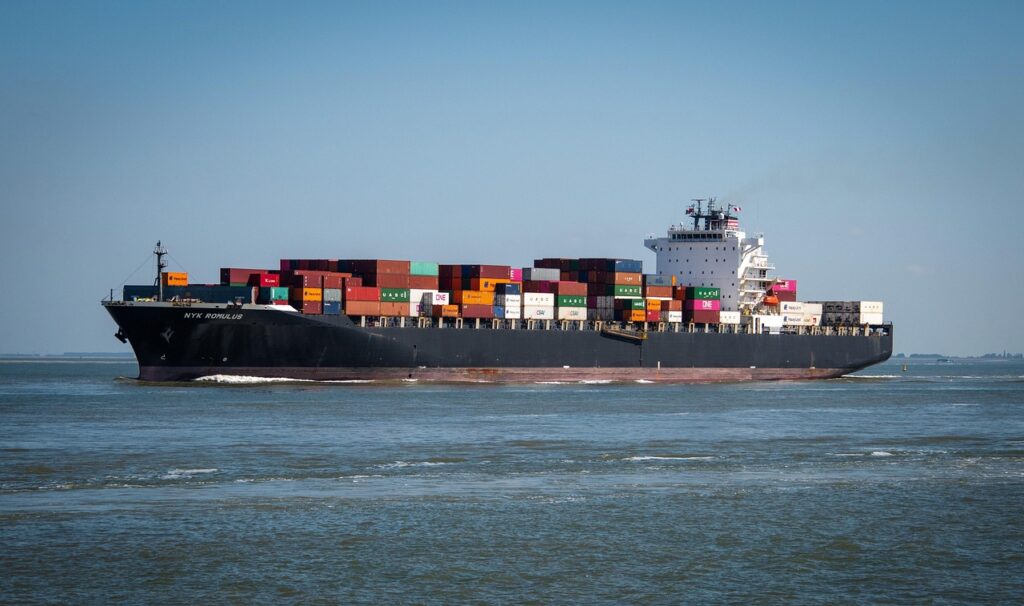
He said in the financial results Q&A session, “From a consumer standpoint, in moments of tensions when there are rising costs, because games are an affordable leisure we tend to suffer less, if not take some opportunities. That’s what we’ve seen in previous crises over the past 10 or 15 years.
“Consumer sentiment-wise, we will see. Although we are always cautious, there is also I think opportunities for us.
“Secondly, in terms of the cost impact. First of all our mix is currently very favourable because trading card games are manufactured very close to where they are sold, like in Europe for European countries mainly – some are manufactured in Asia but its a limited one – in the US for the US, etc.
“Plus they are cheap to transport, so the impact on those is relatively limited. And then we will see with our partners in terms of raw material increases, but again in the overall cost of goods they do not represent a very significant party.
“For board games we have started to see some increase in transportation costs. They did not impact Q4. If we take an example, road freight did represent roughly 20% of the cost base, and they have increased by 10%.
“But again, all of this is quite manageable for us. We expect to be able to mitigate the impact.”
Koegler added that although the process for receiving tariff refunds in the US had begun, after the Supreme Court struck Donald Trump’s swathe of import fees earlier this month, there was uncertainty about both the timing and final amount Asmodee was owed.
He said, “This is still a little bit foggy, blurred – for us, but [also] for many, many other companies out there. So let’s wait for what’s next on this topic.”

[…] anuncia 1.680 millones de euros en ventas netas el último añohttps://boardgamewire.com/index.php/2026/05/22/asmodees-annual-revenue-surges-to-e1-68bn-on-tcg-dist…Los ingresos anuales de Asmodee se disparan hasta los 1.680 millones de euros gracias a su poder de […]
[…] board game distribution is dominated by industry heavyweights Asmodee and Hachette, the latter via its Gigamic and Blackrock […]
[…] distribution remains the engine behind Asmodee’s ongoing growth, with trading card games responsible for more than two-thirds of that quarterly revenue, according […]
[…] global Asmodee Group reported €1.68bn of net sales for the same financial year across its publishing and distribution operations, up 23%, while operating profit was up about […]
[…] generated €1.68bn of net sales in the year to the end of March, up 23% – but more than 72% of that came from distributing games published by other […]