BoardGameWire is proud to be sponsored by:



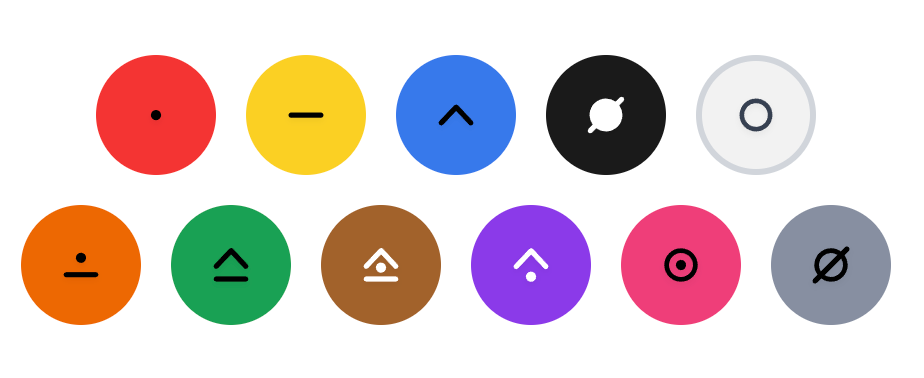

A pair of tabletop game designers have launched a free, open-source colour identification system they hope could become a common accessibility standard across the board game industry.
Colour blindness affects about 1 in every 12 men, and around 1 in 200 women – roughly 300 million people worldwide – and while some board game publishers have made vigorous efforts to make their designs accessible for colour blind players, many games released each year contain challenging colour combinations.
ColorSym began as a solution created by Chris Eastridge for his design Parks & Potions, which centres on combining colours to brew potions.

Eastbridge told BoardGameWire, “My first attempt at adding a meaningful colorblind solution to Parks & Potions put me up against a paywall. It bothered me so much that I was determined to make a system that others could adopt, free of charge, forever.
“We want designers to think, ‘This would make my game more accessible’, and be able to use it immediately. No paperwork, no fees, no asking permission. The easier it is to adopt, the more people it can help.”
Eastbridge created an initial symbol system for ColorSym before collaborating with fellow designer Luis Francisco, the owner of Brazilian board game publisher Grok Games and co-founder of tabletop design project management platform Boardssey, to expand it into a standalone open standard.
The system assigns each colour a simple symbol which can be used alongside colours, allowing players with colour vision deficiency to distinguish components without relying on colour alone.
But unlike bespoke icon systems created by publishers for individual games, Francisco and Eastridge hope they have created a universal visual language that players can learn once and recognise across multiple titles.

The pair have released the symbols under a Creative Commons licence and the accompanying font under the SIL Open Font License, allowing publishers to adopt the system commercially without licensing fees or seeking permission.
“I don’t think any publisher wants to create a game that excludes players,” Francisco told BoardGameWire. “The problem is that there hasn’t been a free, shared standard.
“Most publishers who want to solve this end up creating their own dual-coding system, which means players have to learn a new visual language with every game.
“The other big challenge is orientation. In board games, players see components from every angle around the table. A symbol can’t mean blue from one side and red from another.

“That’s why the omnidirectional nature of ColorSym became such a fundamental part of the project.”
The pair cited multiple ” great examples” of dual coding across the industry, including Mattel adding patterns, symbols, and even tactile clues to some of its games, and Flatout Games soing “an excellent job with continuity of their color-specific components as seen with their Calico line”.
Eastbridge said, “Most solutions for color blindness can be accomplished through using associated iconography. Things like a flame symbol for red, water drop for blue, and so on.
“Where ColorSym comes in is where color has meaning. I think, for those publishers who are looking for a solution to color specific symbology, ColorSym will bridge that gap where unnecessary theming clouds the intent.”
Eastridge said the response to ColorSym from publishers had already been “incredibly positive”, adding that Steelwing Games – the new publisher from industry veteran Scott Morris – had expressed interest in implementing the system in a future release.
And the pair hope board games will be only the beginning.
Francisco said, “One of the very first messages we received after launching ColorSym came from a colorblind person who said ‘I wish these symbols were on my shirts so I could coordinate my clothes more easily’.
“That really stuck with me. Board games are where ColorSym was born, but if it ends up helping people in everyday life too, that would be an amazing outcome.”
Eastridge added, “I feel the same way. We built it for the board game community because that’s where we live, but there’s nothing limiting it to tabletop.
“If someone starts using ColorSym in education, apps, public spaces, or clothing labels, that would be incredible. The more familiar the symbols become, the more useful they become for everyone.”
Downloads, a live specimen, and full documentation are available now at colorsym.com, while the complete source files are available on GitHub.