BoardGameWire is proud to be sponsored by:




The Tabletop Game Designers Association has begun scoring and comparing the standard contracts board game publishers offer to designers, with the aim of improving how game creators are treated and paid.
TTGDA’s inaugural review of contracts from more than 50 board game publishers found “several critical areas where many standard publishing agreements fall short of fair practices”, such as 75% of publishers retaining rights to a game’s name after publication agreements end, and 40% able to develop expansions without consulting the original designer.
TTGDA – a professional organisation launched in 2024 to advocate for tabletop game creators in North America – has spent the last year creating what it calls its Contract Scoring Rubric, which assesses publisher contracts against 110 criteria covering advances, royalties, intellectual property, expansion rights and financial transparency.
While individual scores are available only to TTGDA members, the organisation has published industry-wide findings and identified its five highest-scoring publishers – adding that the benchmarking exercise had already prompted changes from publishers who scored less well.
TTGDA said several publishers have revised their standard contracts after receiving feedback during the review process, with some improving their scores by more than 20 points prior to the report being published.
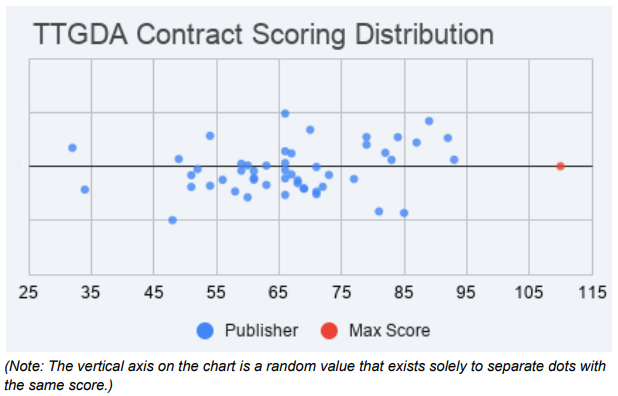
The professional organisation identified 25th Century Games, Fireside Games, Lunarpunk Games, Plaid Hat Games and UP Games as the highest-scoring publishers (in alphabetical order) in its review – adding that the benchmark was intended to help designers negotiate stronger agreements rather than discourage them from working with particular companies.
TTGDA’s inaugural Tabletop Market Contract Analysis report stated, “There is still a wide disparity from publishing contract to publishing contract, and key clauses we believe should be standard are not included in many of them.
“Unfortunately, many first-time game designers are so excited to receive an offer they accept terms that may cause them serious creative and financial issues in the future.
“We encourage all designers, even those signing a game publishing agreement for the first time, to negotiate confidently for their contracts to guarantee fair payment, a formal say in the final presentation of their work, solid protection of intellectual property rights, and control of their names and likenesses in publication and marketing.”
TTGDA pointed to five key takeaways in the report, alongside commentary about why the findings are important to designers. They were:
The analysis also suggests designers often have limited approvals on the final product which bears their name.
None of the publisher contracts reviewed gave designers final approval over artwork or graphic design, while just 38% guaranteed designers the right to review production-ready files before manufacturing.
Only 10% allowed designers to remove their name from a game if they disagreed with creative decisions made during development.
TTGDA’s scoring rubric project was initiated over a year ago by its contract and grievance committee, consisting of industry veterans Geoff Engelstein, Elizabeth Hargrave, Matt Leacock, and James Lowder.

Engelstein, president and co-founder of TTGDA, said, “These results are not a call to avoid specific publishers. Rather they are a tool for designers to negotiate terms that include fair payment, intellectual property protection, and a meaningful role in the final product.”
TTGDA vice president Sen-Foong Lim added, “Our intention is to shine a light on these industry practices and lead to more equitable standards.”
The organisation added that it would be releasing model contracts which adhere to the criteria established in its scoring rubric, to help designers and publishers work towards more equitable deals.
It also plans to release semi-annual updates to the Tabletop Market Contract Analysis as more contracts are reviewed and publishers revise their standard agreements.